Chapter 52 — Relationship Between Countries at Different Levels of Development
Cambridge International AS & A Level Economics (9708) · Unit 11.5 · 4th edition coursebook
Learning objectives
- Describe different forms of international aid.
- Explain reasons for giving aid.
- Evaluate the effects and importance of aid.
- Analyse the role of trade and investment between countries.
- Define the meaning of multinational companies.
- Evaluate the activities and consequences of multinational companies.
- Define the meaning of foreign direct investment.
- Evaluate the consequences of foreign direct investment.
- Explain the role of the International Monetary Fund.
- Explain the role of the World Bank.
Key terms
- International Monetary Fund (IMF)
- An international organisation that promotes free trade and helps countries in balance of payments difficulties.
- aid
- Assistance given to other countries on favourable terms.
- tied aid
- Aid with conditions attached.
- untied aid
- Aid without conditions attached.
- bilateral aid
- Aid given by one country to another country.
- multilateral aid
- Aid given by international organisations to a country or countries.
- virtuous cycle
- The links between, for example, an increase in investment, increase in productivity, increase in income and increase in saving.
- emerging economies
- Economies that are making quick progress towards becoming high-income economies.
- foreign direct investment (FDI)
- The setting up of production units or the purchase of existing production units in other countries.
52.1International aid
Low- and middle-income countries that need to borrow often find it expensive to do so on commercial terms. Many therefore request aid — often called foreign aid — from other governments or international organisations. Aid can take the form of an outright grant, a loan at a reduced interest rate, technical assistance, or the direct provision of goods and services.
Forms of aid
Aid is classified along two dimensions. The first is whether or not it comes with conditions. Tied aid comes with conditions — for example, a grant given on condition that it is spent buying products from the donor country. Untied aid is given without such conditions.
The second dimension is the route by which aid flows. Bilateral aid is given by one country directly to another. Multilateral aid is given by countries to international organisations such as the World Bank or United Nations agencies, which then distribute it.
Reasons for giving aid
The countries that receive the most aid are not always the poorest. The mismatch reflects the different motives behind aid.
Tied bilateral aid can promote the industries of the donor country by requiring the recipient to buy from donor-country firms even when cheaper or better alternatives exist elsewhere. Untied aid can also raise demand for donor-country exports indirectly — if aid lifts the recipient's growth, the recipient imports more, and good aid relationships often make donor-country firms the preferred suppliers.
A second motive is political influence. A recipient government may feel obliged to support the donor in international disputes — for example, joining the donor's trade restrictions on another country.
A third motive is to shape the recipient's economic policies. Both bilateral and multilateral aid may be conditioned on the recipient ending the use of child labour, reducing a budget deficit, or adopting other policy changes.
Finally, aid can be humanitarian — given out of a desire to do good, as with crisis aid during natural disasters and famines. Donors also recognise that helping development raises global GDP and trade and reduces the risk of negative external shocks.
The effects and importance of aid
Aid can raise income per head and development. It can provide investment, or the finance for education, healthcare and new industries that the recipient may lack. Many low- and middle-income economies struggle to invest because savings are low, financial institutions to channel savings from lenders to entrepreneurs are weak, and entrepreneurs themselves may be in short supply.
If investment can be lifted, a virtuous cycle can be set off (see Figure 52.3): more investment → higher productivity → higher income → more saving → still more investment. Aid that breaks the savings constraint at the start of the loop can therefore have effects far beyond the size of the original transfer.
Heavy reliance on aid has disadvantages, however. Some forms of aid leave countries increasingly indebted, and in some cases the interest payments on past loans (even on favourable terms) exceed the current aid inflow, so the net transfer runs the wrong way. Advice and policies suggested or imposed by international organisations are not always suitable for the recipient's conditions — recommending capital-intensive techniques in an economy that has a shortage of capital and a large supply of labour, for example. Requiring a government to cut spending on primary education to reduce a budget deficit can harm development and long-run growth prospects.
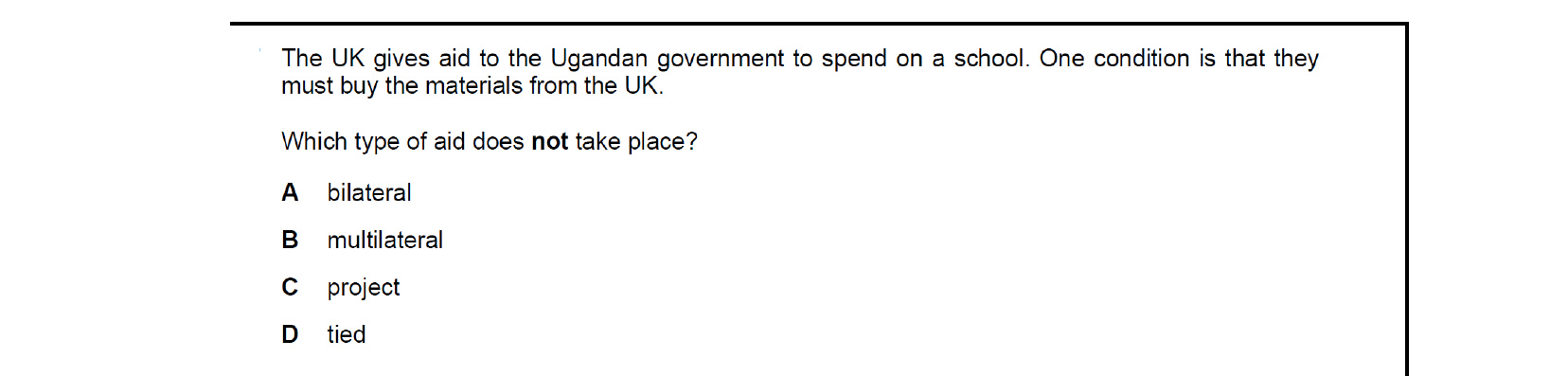
The UK gives aid directly to Uganda — that makes it bilateral. The funds are earmarked for a specific school, so it is also project aid. The requirement to buy materials from the UK makes it tied. What is absent is involvement of an international agency like the World Bank or IMF, which would make the aid multilateral. So 'multilateral' does NOT apply.
52.2Trade and investment
International trade tends to be dominated by high-income countries, which can use greater bargaining power in negotiations to push the terms of trade in their favour. Low-income and some middle-income countries are often pushed into specialising in primary products.
Trade as an engine of growth
Many low- and middle-income governments argue for 'trade not aid' — or, more accurately, for trade on fair terms. International trade can drive growth through several channels: economies of scale become available because the market is larger; competition encourages domestic entrepreneurs to innovate and adopt new techniques; trade transfers skills and technology from high-income to low- and middle-income economies; and specialisation and trade raise incomes, providing the savings that finance investment. Trade also stimulates demand — expansion of exports lifts employment and incomes at home, which then raises demand for domestic output.
The disadvantage of specialising in primary products
Low-income countries that specialised in agricultural products have been at a disadvantage in trading relations because the prices of agricultural products have fallen relative to manufactured goods and services over time. Three reasons explain this:
- The income elasticity of demand for primary products is low, so rising world income produces only a small increase in demand for them, while demand for manufactured goods and services grows quickly.
- Producers of manufactured goods in high-income economies have an element of monopoly power, which they have used to maintain high prices.
- Subsidies given to farmers in high-income countries put downward pressure on global agricultural prices and give those farmers an unfair competitive advantage.
Because the existing pattern of trade is seen by some as exploitative, a number of countries have used import substitution — trying to prevent imports of manufactured goods from high-income economies in order to develop their own manufacturing — while others have pursued export-led growth. Increasingly the secondary sector is becoming more important in low- and middle-income economies, with some gaining comparative advantage in industries once dominated by high-income economies.
Key concept link — Efficiency and inefficiency
On fair terms, international trade can promote efficiency, with countries concentrating on what they are best at producing.
Investment flows
Capital flows between countries in search of profits, interest and dividends. Many low- and middle-income countries run a current account deficit and need a surplus on the financial account to cover it, which is one reason their governments often seek to attract direct and portfolio investment from abroad.
Investment used to flow mostly between high-income countries; more recently there has been growth of investment into and out of emerging economies — those with high growth rates and high expected returns, although in some cases also higher risk. The original BRIC grouping (Brazil, Russia, India and China) was identified in 2001 as an investment opportunity; with the addition of South Africa, the group is now BRICS. Several BRICS economies, notably China and India, are now significant investors in other countries.
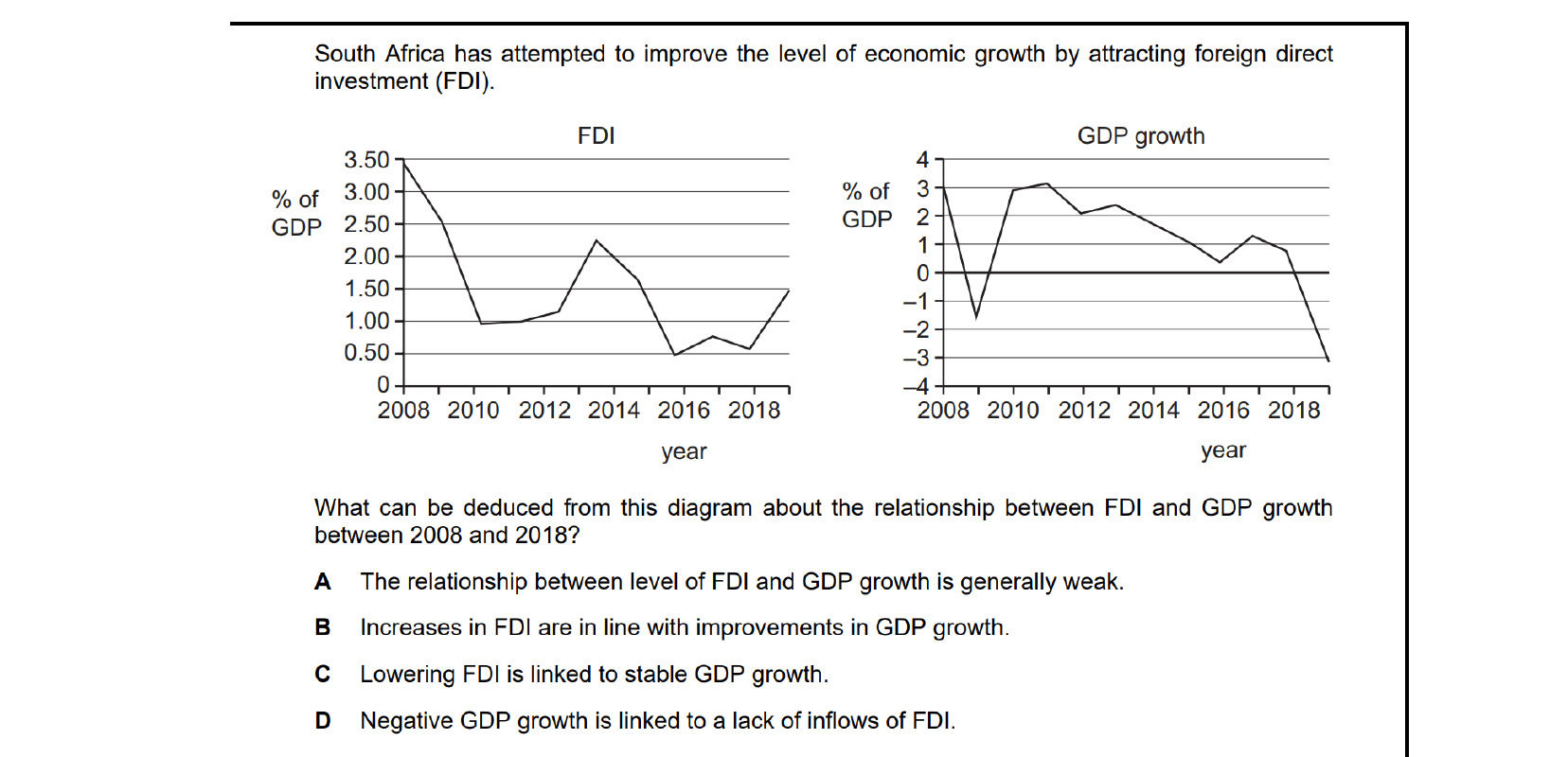
Look at the two charts together: FDI swings sharply between 2008 and 2018 with no matching pattern in GDP growth, and growth rises and falls independently of FDI. The lack of co-movement means the relationship between FDI and GDP growth is generally weak — neither rising FDI nor falling FDI lines up consistently with growth performance.

Cheap labour and land only pay off if the MNC can actually get its goods to market — that needs roads, ports, reliable power and telecoms. Without well-developed infrastructure, transport costs and downtime swamp the wage savings, so factories will not be built. Central-bank independence, privatisation and free repatriation of profits all reassure investors and so attract — not deter — FDI.
52.3The role of multinational companies
One way low- and middle-income countries can lift investment is to attract multinational companies (MNCs). An MNC is a firm that operates in more than one country: a business with a parent company in one country and production or service operations in at least one other. The largest MNCs are global operations with manufacturing and retail outlets in many countries.
Advantages of MNCs for host countries
MNCs can bring new technology and new ideas, add to GDP and exports, and generate employment. They can also bring in foreign direct investment (FDI), which involves capital flows between countries and helps overcome the shortfall of domestic savings that constrains investment in many low- and middle-income economies. MNCs can purchase capital equipment and help develop the country's infrastructure.
Disadvantages of MNCs for host countries
Not all MNCs are welcomed. They may not create higher employment and incomes if they simply replace existing domestic firms. They can deplete non-renewable resources and create pollution. Much of their profit may flow back to the home country, and they may staff the top-paid jobs with foreign rather than domestic workers. Some of the products they sell may not raise living standards. Their mobility and economic power often allow them to negotiate favourable tax breaks and exemptions from environmental laws. A number develop monopsony power as buyers, using it to drive down the prices they pay to the host country's suppliers of raw materials.
Attracting FDI
Countries that attract large inflows of FDI tend to be ones expected to grow rapidly (offering large markets), or ones with low costs of production, or ones with abundant raw materials. Governments use a range of measures to attract FDI, including low corporation tax, a good education system, light rules and regulations, and government subsidies.
Key concept link — Progress and development
In debating the effects of MNCs on low- and middle-income economies, the concepts of progress and development are significant. The presence of an MNC in a low- and middle-income economy may or may not increase its economic growth rate and its effects on living standards may or may not be beneficial.
Key concept link — The margin and decision-making
In deciding where to locate its factories, offices or shops an MNC will consider several locations. It will take into account, for example, the size of the market, the corporate tax rate, whether any government subsidies are available and the quality of the labour force.
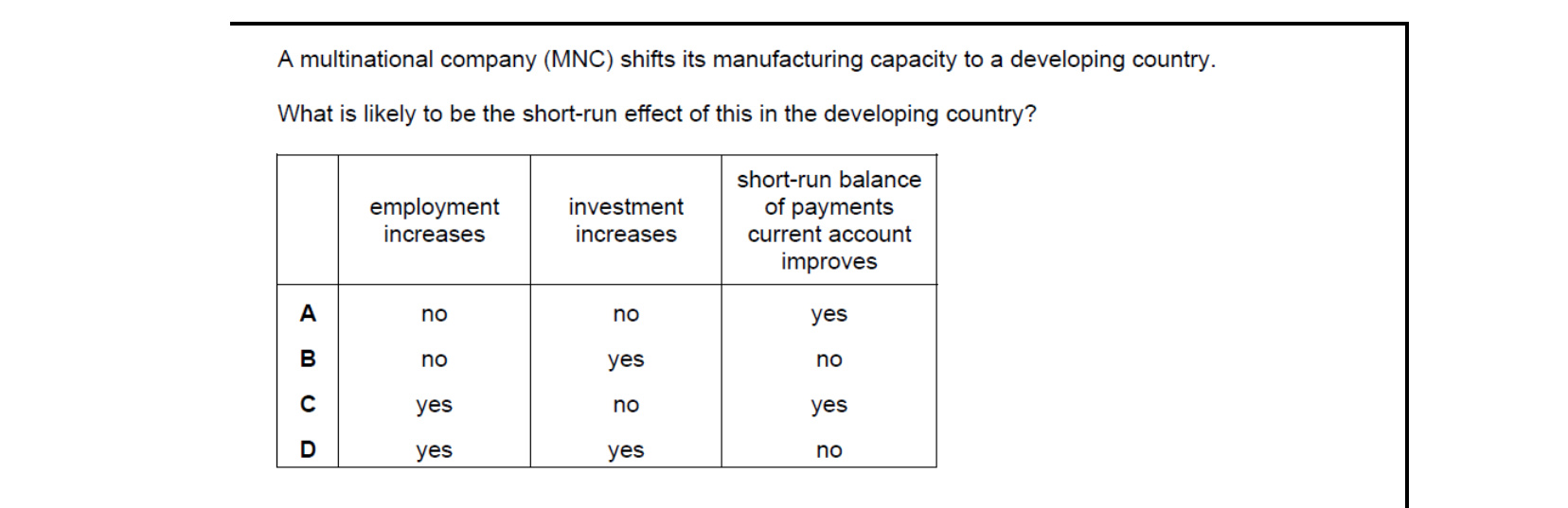
When an MNC opens a new plant, it hires local labour straight away — so employment increases — and the plant itself counts as gross fixed capital formation, so investment increases. But in the short run the MNC has to import machinery and materials, which is recorded as an outflow on the current account. So the BoP current account does not improve in the short run.
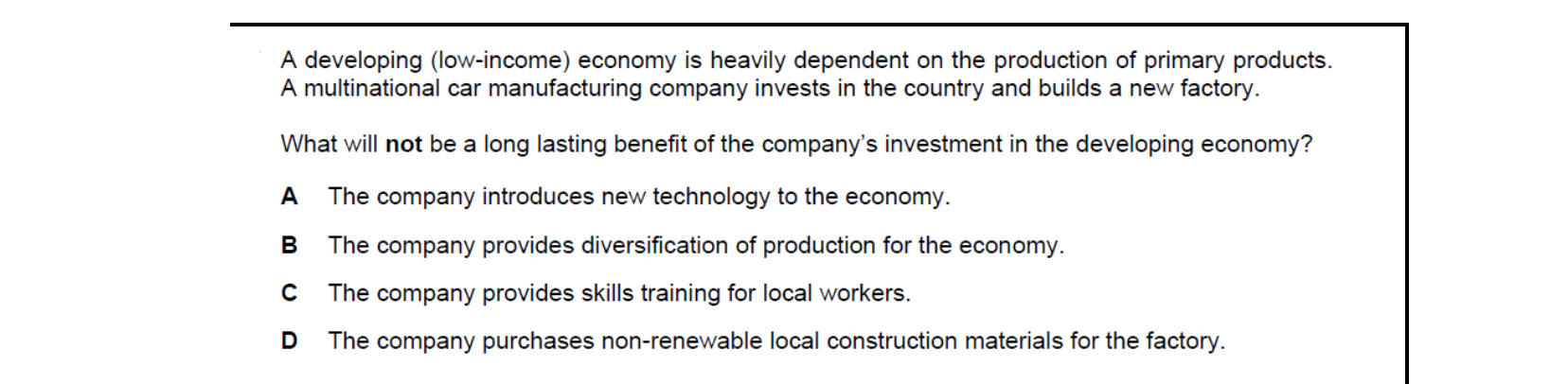
Bringing in new technology, diversifying away from primary products and training local workers all build long-lasting capability in the host country. Purchasing local construction materials — especially non-renewable ones — gives only a one-off boost during the building phase and depletes a finite resource, so it is not a long-lasting benefit.
52.4The causes and consequences of external debt
External debt comprises loans that have not yet been repaid and interest payments that have not yet been made to foreign banks, foreign governments and international organisations. A large share of low-income countries are heavily indebted.
Why countries get into debt
There are four main reasons.
- Structural current account deficit. Even in good times, the country spends more on imports than it earns from exports, or has a net outflow on primary and secondary income.
- Overconfidence about repayment capacity. The country borrowed expecting it could comfortably repay, but its expectations were too optimistic.
- Poor use of borrowed funds. Investments financed by the loans deliver lower returns than the interest cost. If a government borrows at 5% expecting to invest at 8% and the actual return is 3%, it cannot cover the interest.
- Unexpected events. An unforeseen depreciation of the exchange rate raises debt repayments because interest is usually paid in dollars. Negative demand and supply shocks — a global recession that reduces export demand, or a natural disaster that disrupts export supply and creates a need for emergency aid — can also push debt higher.
Consequences of external debt
A high external debt can be a major obstacle to future development. Servicing the debt diverts funds away from improving welfare and raising the economy's growth potential. A heavy debt burden also makes it harder and more expensive to attract new funds: credit ratings fall and interest rates on new borrowing rise.
Some governments respond by defaulting — refusing to repay past loans — judging that protecting spending on education and healthcare matters more than meeting their obligations. The trade-off is that defaulting damages access to future borrowing.
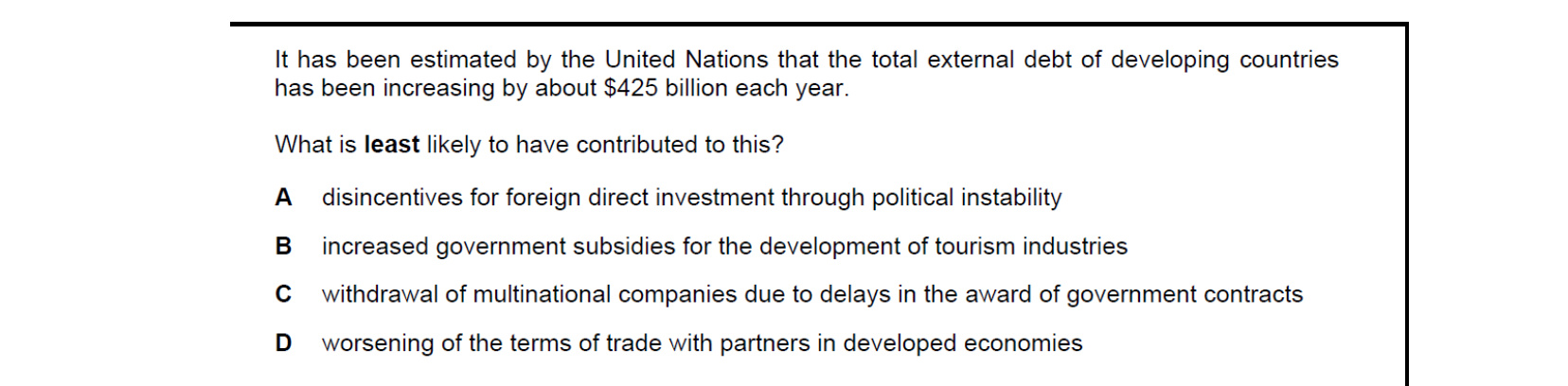
External debt rises when countries borrow more — driven by political instability (which scares off FDI and pushes governments to borrow), MNCs withdrawing (cutting capital inflows and tax revenue) and worsening terms of trade (lower export earnings vs imports). Government subsidies to develop tourism, by contrast, support a foreign-currency-earning industry that helps repay debt — so this is the least likely contributor to rising external debt.
52.5The role of the International Monetary Fund and the World Bank
The International Monetary Fund (IMF) and the World Bank are two of the best-known and most influential international organisations. Both were set up in 1944 and have their headquarters in Washington, DC.
The International Monetary Fund
The IMF's primary aims are:
- to promote international monetary cooperation;
- to facilitate the expansion and balanced growth of international trade;
- to promote exchange rate stability;
- to assist in setting up a multilateral system of payments;
- to make resources available (with adequate safeguards) to members experiencing balance of payments difficulties.
These activities have been central to the development of global trade: a stable system of international payments and exchange rates is needed for trade between countries to take place. The IMF has three main functions in pursuit of these aims: surveillance, technical assistance and lending. The first two encourage countries to adopt sound economic policies. The third is used when member countries face difficulties financing their balance of payments.
The World Bank
The World Bank's original aim was to help rebuild European countries devastated during World War II. Today it offers support to low- and middle-income countries through investment in projects such as building new roads, improving infrastructure, and constructing new health facilities. It comprises five institutions: the International Bank for Reconstruction and Development (IBRD), the International Development Association (IDA), the International Finance Corporation (IFC), the Multilateral Investment Guarantee Agency (MIGA), and the International Centre for Settlement of Investment Disputes (ICSID). The IBRD assists middle-income and creditworthy poorer countries, while the IDA focuses on the poorest. Grants are provided only to the world's poorest economies.
World Bank loans cover areas such as:
- Health and education — improving sanitation, combating HIV/AIDS, raising human development.
- Agriculture and rural development — irrigation programmes and water supply projects.
- Environmental protection — reducing pollution and ensuring compliance with regulation.
- Infrastructure — roads, railways, electricity.
- Governance — including anti-corruption work.
The Washington Consensus and criticisms
Loans from these institutions tend to come with conditions involving wider-reaching changes to the recipient's economic policies. The IMF and World Bank have been criticised for imposing the so-called 'Washington Consensus' — a set of ten policy prescriptions devised by a US economist, including privatisation, deregulation and trade liberalisation, all aimed at increasing the role of market forces. Such an approach may raise efficiency and increase productive potential. It may also increase income inequality, however, and may not work if the problem holding back development is not too much government intervention but market failure and a lack of financial markets.
End-of-chapter practice
Past-paper questions from CIE 9708. Pick A, B, C or D. Answers are saved on this device — press Download report (PDF) at the top to save them.
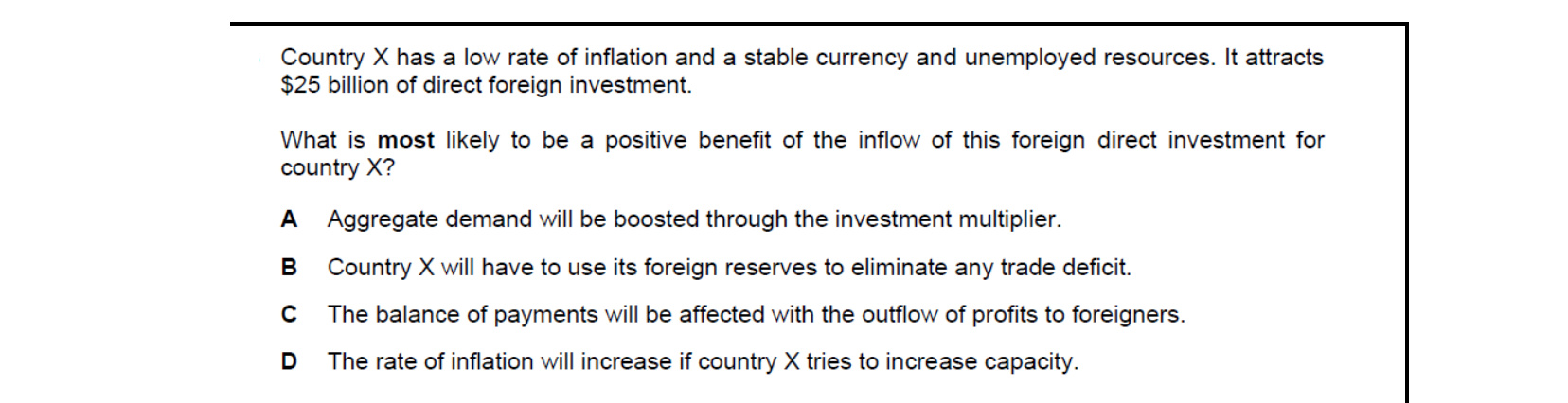
With unused resources, a stable currency and low inflation, the country has scope for an injection to expand output without overheating. A $25bn inflow of FDI directly boosts investment spending, which generates further rounds of consumption — aggregate demand is boosted through the investment multiplier. That is the most likely positive benefit; the other options are negatives or costs.
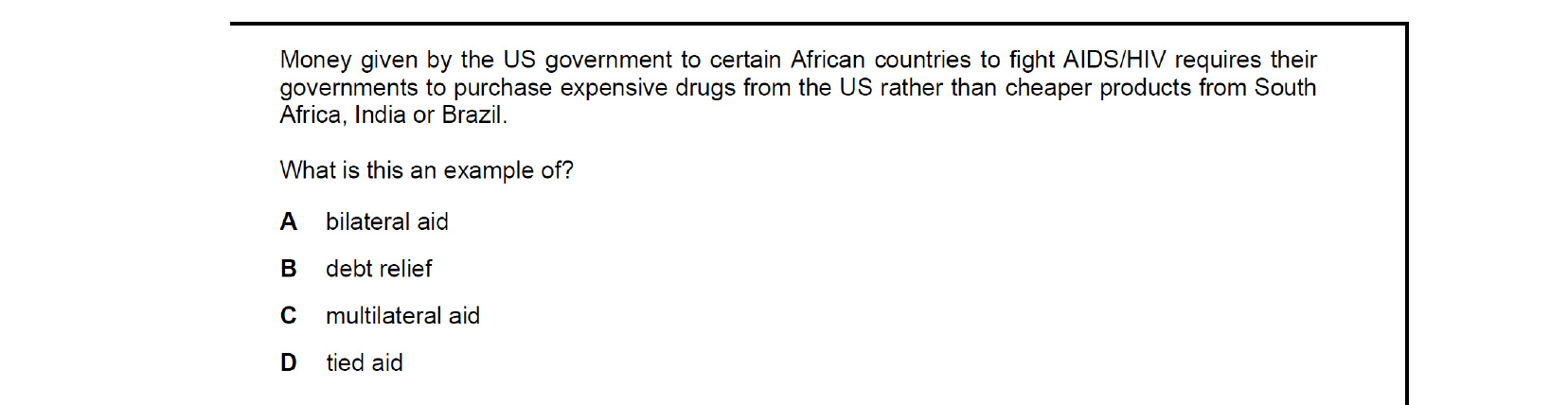
The donor (the US) gives aid on the condition that the recipient must buy specific drugs from US suppliers rather than cheaper alternatives. That string attaching the aid to purchases from the donor country is the textbook definition of tied aid. It is also bilateral, but the feature being highlighted — the purchase requirement — makes 'tied aid' the precise description.
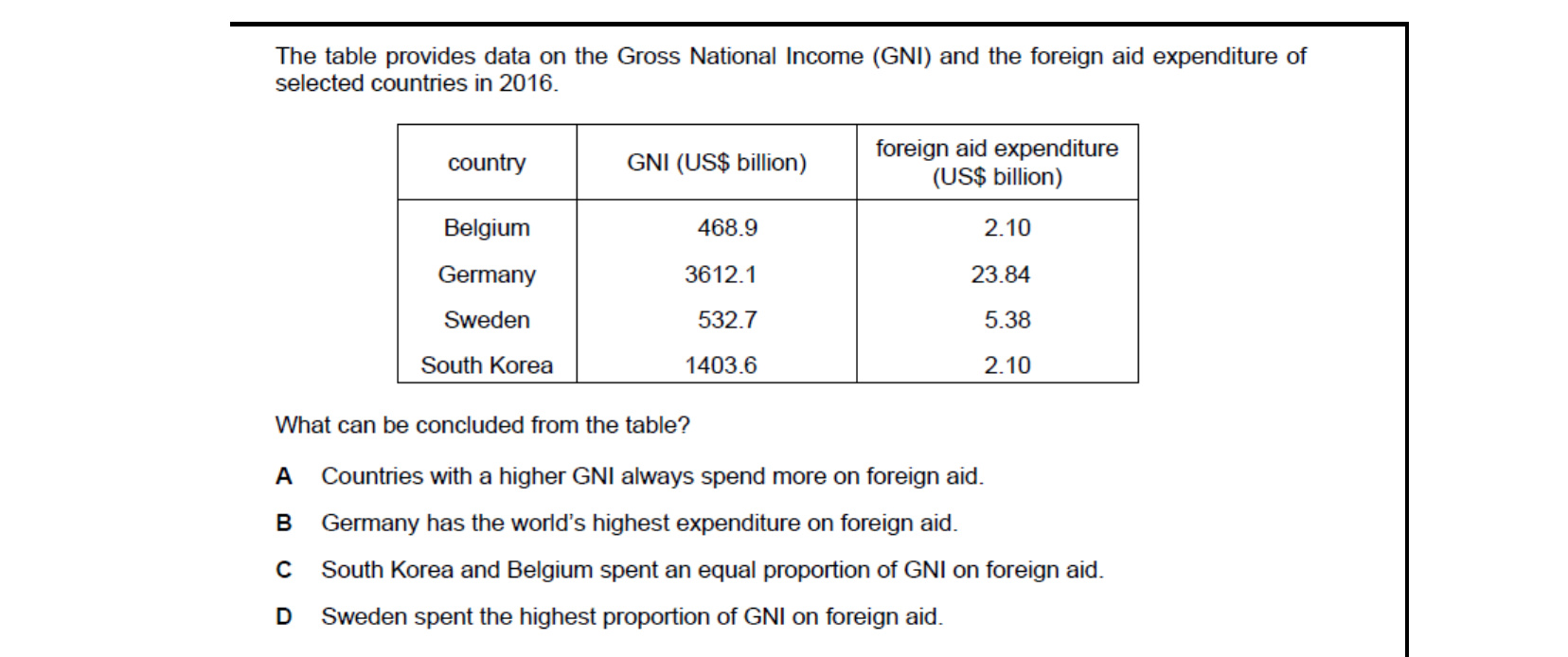
What matters for aid effort is share of GNI, not the absolute amount. Sweden gave 5.38 on 532.7 — about 1.0% of GNI — easily the highest ratio in the table. Germany spent more in dollars but only ~0.66% of a much larger GNI; Belgium and South Korea spent very different proportions despite identical dollar amounts. So Sweden spent the highest proportion of GNI on foreign aid.
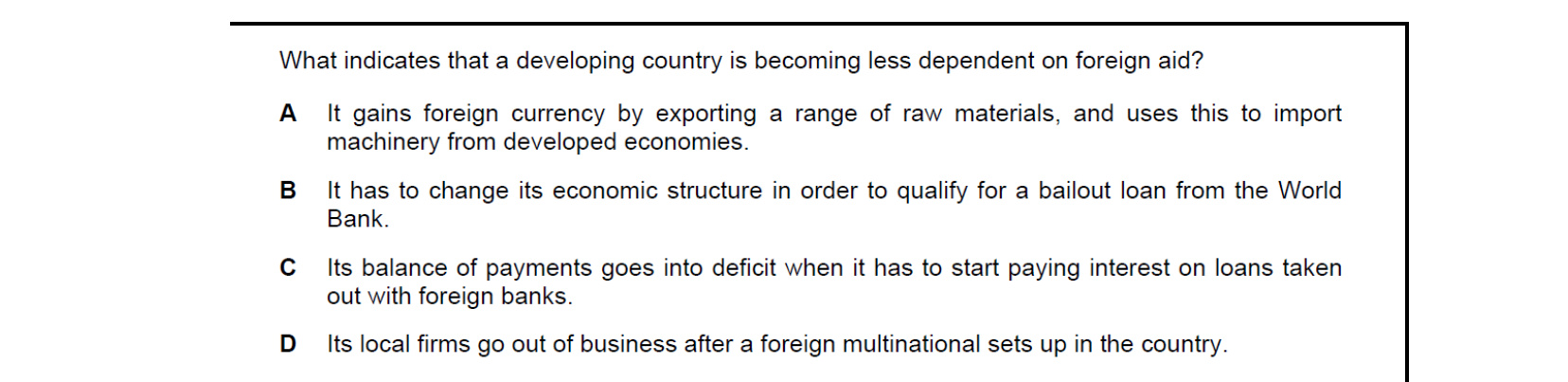
Falling aid dependence means the country can fund its own imports of capital goods through its own export earnings. Earning foreign currency from a range of raw-material exports and using it to buy machinery from developed countries is exactly that: financing development through trade rather than handouts. The other options reflect deeper dependence (bailouts, debt problems) or losses to MNCs.
Attempt the practice questions above to build your score.
Self-evaluation checklist
After studying this chapter, you should be able to:
- Recognise that international aid may be tied, untied bilateral or multilateral.
- Explain that aid may be given for economic, political or humanitarian reasons.
- Consider the effects and importance of aid to receiving countries.
- Analyse the role of trade and investment between countries.
- Describe the role of multinational companies (MNCs).
- Analyse the impact of MNCs' activities on different economies.
- Evaluate the impact of foreign direct investment provided by MNCs to the countries in which they operate.
- Explain the roles of the International Monetary Fund and the World Bank.
Want more practice? Drill this chapter's past-paper MCQs (42 questions) →